Thursday, December 20, 2012

Party like there is no tomorrow...


   Is it just me?

   Does anyone else feel like the Mayan's made their calender so the world would have the ultimate excuse to party?

   If so, they definitely sent out the invitations in plenty of time. And publicity.... WOW. This party has been publicized world wide for years. (I know there are plenty of PR people that are green with envy.)

   So everyone out there, grab your favorite beverage and toast all your friends and loved ones. If the world doesn't end tomorrow.... oh well, I guess we will just have to throw another end of the world party later.


Click On The Image To Know More About The 6TH Festival Of Life & Death Traditions At Xcaret!!
Some people have been waiting decades for this party.

Monday, April 30, 2012

W, Y and Z is for...


Click the badge to visit the other bloggers.

   Okay so if I was stopped by the cops and given a field sobriety test I would fail the alphabet. Blame it on sleep deprivation. I do know that W comes before X... honest I do.

   Well here is the misplaced W. W has 2 flowers I couldn't decide between. The first one is "Winecup"  Callirhoe involucrata. I just love the name and the look of these little flowers. They are everywhere in the spring. They bloom through out the state, except in far West Texas, from February to June.

Callirhoe involucrata
Picture from University of Texas Plant Resource Center
    The second W is "Wild Azalea"  Rhododendron canescens. You see many cultivated Azalea through out Texas, Houston even has the Azalea Trails every spring. But there are also 2 native Azalea plants in the east Texas woods. This one blooms in early spring before or just as the leaves start to emerge. Look for the flowers from February to May.

Rhododendron canescens
Picture from University of Texas Plant Resource Center

   For Y I had to pick this showy flower..."Yellow Lotus"  Nelumbo lutea. This plant has completely round leaves. The fruit and center of the flower actually look like shower heads. It is also relation of the sacred lotus of Asia, and can be found in muddy quite ponds in Eastern and Northern Texas. This lotus puts on its show from May through August.
Nelumbo lutea
Picture from University of Texas Plant Resource Center
Nelumbo lutea
Picture from University of Texas Plant Resource Center

  And for my last wildflowers of Texas, I present the Zinnias. There are actually 2 in Texas "Desert Zinnia"  Zinnia acerosa and "Plains Zinnia"  Zinnia grandiflora. Both are relitives of the fimiliar garden zinnia. The Plains Zinnia is found in the western half of Texas and starts its blooming period in June, a month earlier than it cousin. The Desert Zinnia can be found in far West Texas and the southern tip of Texas. The Zinnia bloom from July through November.

Plains Zinnia
Zinnia grandiflora
Picture from University of Texas Plant Resource Center


Desert Zinnia
Zinnia acerosa
Picture from University of Texas Plant Resource Center

  This concludes our wildflower trip in Texas. I hope you have enjoyed and learned as much as I have. I have just touched on the Wildflowers of Texas. There are over 120 different flowering plants, not to the mention flowering trees through out the state. So next time you come don't forget to take a closer look at all the things around you.... you just might find something wonderfully unexpected.

  There are many great sites out there for wildflowers the one I used the most was from the University of Texas check out there Wildflowers of Texas site here. Another great site for wildflowers, not only Texas ones, is the Lady Bird Johnson Wildflower Center, you can find it here.

U, V and X are for....


Click the badge to visit the other bloggers.

   I am so far behind, that I will have to do multiple letters. Jack has been back in the hospital. So I was there too. No computer... well no to get to the flowers.

  U is for "Unicorn Plant"   Proboscidea louisianica  subsp.  Fragrans. When you hear the name you might think of this guy or gal...
Unicorns In Water
Click here to getImages &
 But this flower is actually a member of the common "Devil's Claw". The seed pods of this plant when rip will split in half and hook themselves on to the clothes or fur of anything passing by. The plant grows in West Texas and though an annual it can form clumps up to 6 feet wide. The foliage is sticky and unpleasant smelling with blooms from June through September.

Proboscidea louisianica
Picture from University of Texas Plant Resource Center

    V is for "Violet Ruellia"   Ruellia nudiflora  var.  nudiflora.  This pretty little flower can be found in central and southeastern Texas. It grows anywhere including yards, where it is considered a weed, though a very pretty one. The ruellia blooms from February to November, but more abundently in the early summer. It is sometimes called a wild petunia, but it is not related to the petunia plant at all. The deer love the leaves and bobwhite quail eat the seed of this plant.


Ruellia nudiflora
Picture from University of Texas Plant Resource Center
   No for X. First let me explain when I started these post I decided to use common names instead of scientific. That has worked out great....until now. There is no x common name, so I took a little liberty to post Xtra pictures that I have taken of wildflowers around my area.


Stinging Nettle... I stood waaay back for this one.


This little flower only blooms at night, I had to head out with the flashlight for this one.

  If you would like to see others I have taken check out this blog post... Signs of Spring

Since this is the last day I have another post scheduled for 1:30pm central time so that I may actually finish with everyone else.

Monday, April 23, 2012

T is for....


Click the badge to visit the other bloggers.

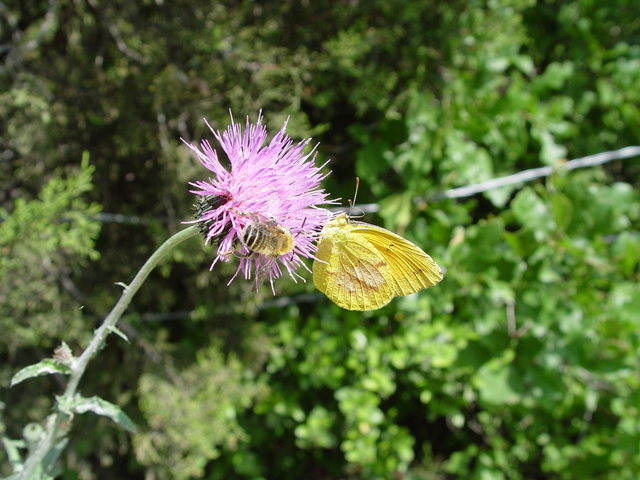
   Today I have 2 more plants that are edible. One you probably already know about and one you may not. The first is "Texas Thistle" Cirsium texanum. This plant grows through out the state, except the Panhandle and the Pineywoods. The young leaves can be eaten raw in a salad or cooked. The tap root is also edible, and I read that when cooked the flavor resembles the artichoke. The stem fibers of the thistle plant can also be used as thread. 
   The Texas Thistle blooms from April through October.

Cirsium texanum
Picture from University of Texas Plant Resource Center

  As you can see others think it pretty good food too.                                  

Photo by Melody Lytle of Travis.Tx

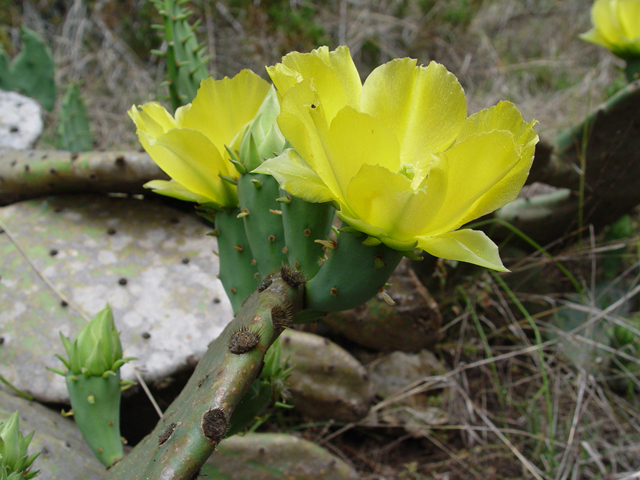
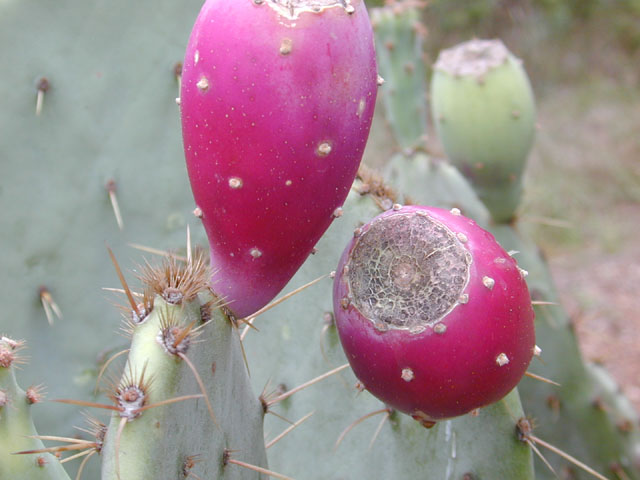
   The second edible plant on today's list is "Texas Prickly Pear"   Opuntia engelmannii  var.  lindheimeri. The Prickly Pear is one of the most well recognized of all the plants in Texas. It grows abundantly through out most of the state. The flowers on this castus can be yellow or orange. The orange being the most common in south Texas. During droughts it can also be used as emergency food for cattle. The prickly pear or tuna of the plant is delicious and the flat succulent leaves when the spines are removed are cooked as "nopalitos". Beware that older pads contain oxalic acid and may cause oxalic acid poisioning if eaten to excess.
   The cactus blooms from March through July, and is a feast for the eyes.

Opuntia engelmannii
Picture from University of Texas Plant Resource Center
Photo by Melody Lytle of Travis.Tx
Photo by Joseph Marcus of Austin, Tx

Saturday, April 21, 2012

S is for....


Click the badge to visit the other bloggers.

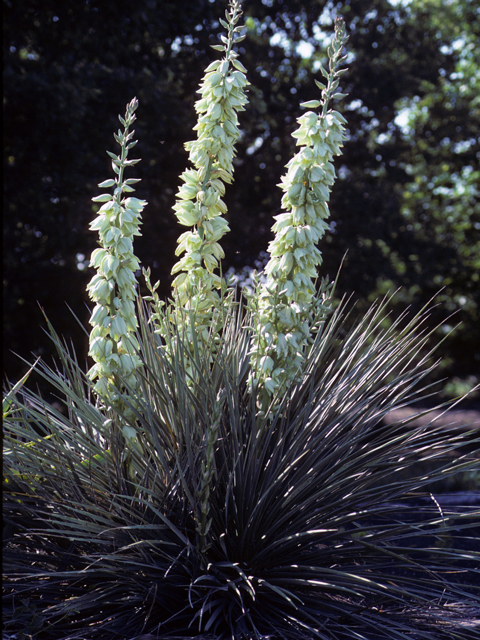
   Okay S is a really hard one for me. Not because it is hard to find an S plant, but because there are too many interesting S plants. But one of the most interesting has to be the "Spanish Dagger"   Yucca treculeana. Not because it is a beautiful flower, even if it is, but because of its unique relationship with its pollinator the Yucca Moth. Their relationship is such that one cannot live without the other.  The small short lived moth does not have a long tongue like other moths and butterflies, but has testicles under its chin. The adult life is so brief they don't eat. After emerging from their cocoon, the male and female meet and mate in the blooms of the plant. The female then scraps up pollen from the flower of the Yucca and holds it under her chin. She then flies to another flower on another plant and searches for a flower in the right stage of bloom. She checks to make sure no eggs are already laid in the flowers ovary. The females can smell the scent of other females. If another female has laid eggs, she moves on to another flower. If too many eggs are laid in a blossom the plant will get rid of the flower and the eggs will die. So the female make sure of the survival of her offspring by laying only a limited number of eggs per flower. After she has laid the eggs, she goes to the stigma of the flower and spreads the pollen she collected on it to ensure pollination. 
   The flowering months of the "Spanish Dagger" is only 2 months March and April. The plant grows in the deep south of Texas.

Picture from the Wasowski Collection at Wildflower.org

Tegeticula sp. Photo by M.J. Hatfield, BugGuide.net

   One other very interesting plant in S is the "Spotted Beebalm"   Monarda punctata  var.  lasiodonta. All the Beebalms have a strong fragence when brushed or crushed (Lemon Beebalm can be used to repel mosquitoes). This version of the Beebalm or Horsemint has a strong fragrance of thyme and has the antiseptic compound thymol. This compound has been used in cough syrups and in the past has been used for the commercial source. This plant can be found in most of Texas except the extremly dry areas of West-central, West and Deep South Texas. The Beebalms bloom from April through August.


Picture from University of Texas Plant Resource Center

   I had to show the pictures of these beauties as well. The information can be looked up on the UT Library here.

Southern Lady's Slipper   Cypripedium kentuckiensis 
Picture from University of Texas Plant Resource Center

Strawberry Cactus   Echinocereus stramineus 

Echinocereus stramineus
Picture from University of Texas Plant Resource Center
Silky Camellia  Stewartia malacodendron

Stewartia malacodendron
Picture from University of Texas Plant Resource Center